ABADILAH SAHABATKU

Sahabatku...

Akhir Desember 1994 ketika itu aku telah menyelesaikan study di sebuah Universitas Negeri yang ada bagian Indonesia Timur yang tepatnya di Universitas Cendrawasih,pada saat itu juga saya berniat untuk merantau yang kebetulan waktu itu saya ada saudara sepupu berada di Jambi,bekerja di sebuah Perusahaan Industri Kayu Lapis (Triplek).Berawal dari situlah aku ingin ikut dia,belajar hidup jauh dari orang tua,memang kehidupan kelurgaku bukan dari orang yang berada,melainkan keluarga yang hidup dengan keuangan pas pasan.

Banyak cerita yang sudah kita lewati bersama, masa dimana kita merajut mimpi dan menggapai asa kita. Dan ketika sang waktu memisahkan kita, maka kenanganlah yang selalu hidup dalam benak kita.Aku pergi meninggalkan kampung halaman bukan karena aku tidak betah.Aku pergi hanya karena sesuap nasi.Meskipun kehidupanku bersama kedua orang tua dan kakakku masih boleh dibilang lumayan.Itu memang adalah sebuah panggilan hidup demi mencari nafkah meskipun di pulau seberang sana.Kutinggalkan sahabatku pergi merantau,namun aku tak pernah melupakan mereka meskipun sudah puluhan tahun lamanya.

Pada saat itu dengan penuh kesedihan keluargaku kutinggalkan meski banyak orang yang melarang keberangkatanku,namun kucoba meyakinkan mereka bahwa nanti kalau aku sudah setahun aku akan pulang apabila sudah dapat pekerjaan.Akhirnya janji itu saya tidak tepati,di tahun 1998 baru saya pulang.Empat lamanya baru terkabul niat untuk pulang,keluargaku begitu antusias memikirkan nasib dan keadaanku selama di rantau orang.Tapi selama kurun waktu empat tahun itu aku sering kirim surat mengabarkan keadaanku sebab saat itu telepon genggam belum begitu populer.

Kita berpisah bukan untuk tak berkata atau kita berpisah bukan untuk tak bersua tapi kita berpisah hanya karena jarak yang membentang di antara kita, jalinan tali persaudaraan dan persahabatan kita akan tetap  selalu mengikat dan menghubungkan kita.Kepulanganku di tahun 1998 itu mengadung banyak polimik,sahabat sahabat yang kutinggalkan juga sudah pada merantau,ada yang ke Kalimantan,Irian dan bahkan ada juga yang masih berada dikampung halaman,hanya saja mereka tinggal di Kabupaten lain.Tak satupun sahabat saya yang bisa saya temui,empat tahun berikutnya Allah memberikan saya rezeki dan pulang,merekapun tak kutemui,namun saya bergumam dalam hati suatu saat akan bertemu juga.Keadaan keluargaku (ibu,bapak dan kakak perempuanku) masih dalam keadaan sehat wal'afiat,Alhamdulillah kami masih beserta keluarga masih diberikan umur panjang dan kesehatan namun sahabatku tidak ada satupun yang kudapatkan,menurut cerita orang tuanya mereka sudah berkeluarga dan memilih tinggal di kampung halam istrinya.Hatiku tetap ceria walaupun tidak bertemu dengan mereka.

Sahabatku..
Ketika seseorang berkata bahwa dunia ini tak indah tanpa adanya dirimu, maka dia berkata benar... Dan ketika seseorang berkata bahwa dunia ini sepi tanpa adanya dirimu maka dia juga berkata benar... Karena ketika seseorang tidak mengenal dan memilikimu maka dia sebenarnya telah menghilangkan keindahan dunia dan melewatkan begitu berharganya kehidupan ini dari-nya.

Sahabat...
Ketika seorang pujangga berkata bahwa cinta adalah kelemahan alam yang ditimpakan kepada kita oleh manusia pertama, maka aku akan berkata bahwa sahabat adalah kekuatan alam yang diwariskan kepada kita oleh manusia pertama untuk menangkal lemahnya cinta, karena dirimu adalah wujud dari cinta dan kasih sayang..

Sahabat...
Cerita kita tidak berakhir hanya karena adanya sebuah tulisan ini tapi kisah kita akan berlanjut, menggema dan bersuara nyaring seperti kicauan burung di pagi hari sampai dimana masa ini sudah tidak lagi menaungi kita.

Sahabat..
Sang maha cinta telah mengirimkanmu sebagai sahabatku, dengan demikian dirimu menjadi teman tarikan nafas dalam lautan perasaan, menjadi sandaran dalam air mata langit kesedihan dan menjadi bagian terlengkap dalam senyuman dari kebahagiaan dunia jiwaku.

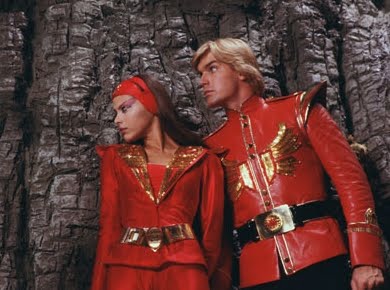
FLASH GORDON

Flash, Dale, & Dr. Zarkov kick Ming the Merciless's A$$ and SAVE the planet ..

GO FLASH GO !!!!


FLASH ... Ahhh hahhhhhh ..

He'll Save Everyone Of Us ..


Flash Gordon is a 1980 science fiction film, based on the eponymous comic strip character Flash Gordon, created by Alex Raymond. The film was directed by Mike Hodges and produced and presented by Dino De Laurentiis. It stars Sam J. Jones, Melody Anderson, Chaim Topol, Max von Sydow, Timothy Dalton, Brian Blessed and Ornella Muti. The screenplay was written by Lorenzo Semple, Jr., and adapted by Michael Allin. It intentionally uses a camp style similar to the 1960s TV series Batman (for which Semple had written many episodes) in an attempt to appeal to fans of the original comics and serial films. The film is notable for its soundtrack composed, performed and produced by the rock band Queen (although orchestral sections were by Howard Blake).


The story opens with the voice of Emperor Ming the Merciless (Max von Sydow) indicating he will destroy Earth with a variety of seemingly natural disasters.
Sometime later on Earth, New York Jets football star “Flash” Gordon (Sam J. Jones) boards a small plane when the “hot hail” begins. Onboard, he meets travel journalist Dale Arden (Melody Anderson) who is also flying back to New York City. Mid-flight, the disasters become progressively worse and the pilots disappear from the cockpit. Flash takes control of the plane, and manages to crash lands in a greenhouse owned by Dr. Hans Zarkov (Chaim Topol). According to Dr. Zarkov's research, the disasters are being caused by an unknown physical source in space which is sending the moon out of orbit and toward the Earth. Zarkov had been secretly working on a rocket ship for several years to test his theory, and now intends to go to the coordinates for the source of the attacks. He accidentally launches the rocket during a fight with Flash and all three fly off into space, even sailing into the black hole where they finally land on the planet Mongo. There, they are taken prisoner outside a grand city.
Flash, Dale and Zarkov are brought before Ming the Merciless. Ming hypnotizes Dale and orders her to be removed and prepared for his pleasure, but Flash openly defies Ming and picks a fight with his men, adapting his athletic skills from American football. Ming orders Zarkov into Klytus’ custody for reconditioning and orders Flash's execution. Following Flash's disposal, Princess Aura (Ornella Muti) and Ming’s Chief Surgeon, one of her numerous lovers, open Flash’s casket and resurrect him. Zarkov is delivered to Klytus, who straps him to a table and uses a machine to empty his mind. Once complete, they begin to reprogram him. Aura and Flash quickly retreat to Arboria, kingdom of Prince Barin (Timothy Dalton), the main lover of Aura.
En route to Arboria, Aura teaches Flash to use a telepathic communicator so that he can contact Dale and let her know he is still alive. Aura takes advantage as Flash tries to concentrate on talking to Dale, Aura tries to kiss and seduce him, but Flash is able to hide what is happening from Dale. Relieved, Dale informs Flash that she is locked in Ming's bedchamber. She is served a hypnotic drink that keeps her in a relaxed and loving state towards Ming. She tricks the lady who brings the drinks to her into drinking them and the woman soon becomes relaxed and Dale changes clothing with her and escapes. Dale fights with guards and manages to get away. She runs into a reconditioned Zarkov (who managed to resist Klytus’ reprogramming) and informs him that Gordon is alive. The two subsequently escape, but they are quickly captured by Prince Vultan (Brian Blessed)’s Hawkmen and taken to his kingdom, Sky City.
Aura and Flash arrive at the forest moon Arboria. Aura asks Prince Barin to keep Flash safe. Barin, who is in love with Aura (but does not trust her), agrees not to kill Flash. Barin then places Flash in a cage and deliberately allows him to escape into a sacred Temple, where Barin recaptures him and insists that Flash participate in a deadly ritual as a consequence of his trespassing. The two men take turns sticking their hands into a hollow stump with a poisonous creature inside. When Barin compels Flash to take an extra turn, Flash pretends to be stung by the creature and begs for a quick death. As Barin prepares to strike, Flash grabs his weapon and escapes into the forest. Barin follows, but they are both captured by Prince Vultan’s Hawkmen.


Klytus (Peter Wyngarde) informs Ming of Flash's resurrection and requests Ming's authority to pursue the investigation which Ming agrees to. Aura returns alone to Mingo City only to be taken prisoner and violently interrogated by Klytus and General Kala. They eventually get a full confession and Ming orders Aura to be banished to the ice world Frigia after his wedding.
Flash and Barin are captured by the Hawkmen and taken to Sky City, where Flash and Dale are briefly reunited. Flash is forced to fight Barin to the death, but when Flash spares Barin's life, Barin finally realizes that Flash can be trusted and that they must join forces against Ming. Klytus arrives to arrest Barin and Zarkov for treason and recapture Dale, but Flash and Barin double-team Klytus and kill him. In a panic, Vultan orders all the Hawkmen to evacuate, leaving Barin, Flash, Dale and Zarkov behind. Ming’s ship arrives shortly afterwards and he orders Barin, Zarkov and Dale to be taken aboard his ship. Ming finds himself impressed with Flash, and offers him lordship over a subjugated Earth in exchange for Flash's life which Flash refuses. Ming returns to his ship and gives the order to destroy Vultan’s kingdom with Flash still on it. But once again, Flash cheats death by Ming by finding a rocket cycle in the city and escaping before Sky City is destroyed.
Flash contacts Vultan, whose people have found refuge on Arboria, and plot an attack on Mingo City. General Kala (Mariangela Melato) learns of Flash's solo attack on the city and orders weapons to open fire at him. Kala dispatches the war rocket Ajax to bring back Flash's body; but the Hawkmen army intercepts and, after a huge battle, Flash and the Hawkmen seize control of the rocket. In Mingo City, Princess Aura overpowers her guard and makes her way to the execution chamber, freeing Barin and Zarkov. Kala orders the city's weapons to fire upon Ajax (with Flash at the helm and Hawkmen in tow), as Ming and Dale’s wedding starts.
Barin manages to destroy the lightning field and Ajax plummets into the city; the ship's bow impales Ming as all others flee to safety. The impact throws Flash around in the rocket, dazed but uninjured. Ming falls off the rocket nose as Flash offers him life in exchange for the Earth's safety. Ming attempts to use his power ring on Flash but his power falters and nothing happens. He then aims the ring at himself and is seemingly vaporized by its remaining power. Ming's robot servant declares that Flash has saved the Earth and a huge victory celebration ensues. Barin is announced as the rightful heir to Ming's vacant throne. The newly-appointed King Barin shows his gratitude to Flash, appoints Vultan as the new Genral of the Armies, and decrees that all the kingdoms of Mongo shall live together in peace. Flash and Dale embrace, their future (and Zarkov's) left open for either a return to Earth or continuing adventures on Mongo.
The last scene focuses on Ming’s empty power ring, as an unidentified individual picks it up. “The End?” fade onto the screen, followed by an echo of Ming’s evil laughter...


Trail of the Orient Express


Taking an ancient car ferry over the Tisza River
We’re heading into Transylvania today. The skies should be leaden, with lightning strobing in the wet gloom and thunder grumbling like a distant artillery barrage. Instead we’re travelling in bright sunshine and a soft summer breeze. No Hollywood cliches here.
We know today is going to be a slow day — the four lane highway finished just outside Szeged, and according to the map, the next time we’ll see one is somewhere near Bucharest — but we are a little surprised when the Garmin directs us down a string of back roads to an ancient car ferry over the Tisza River. We are even more surprised to have to wait 20 minutes to board the thing, even though it is pulled up on our side of the river. Seems the ferry departs every half hour — even though the river is only a couple of hundred yards wide and takes about 10 minutes to cross.
On the Trail of the Orient Express   Day 5 image
The road the other side is a challenge. It is tarmac, but its foundations are so poor it has collapsed into a series of humps and hollows that would challenge the suspension on a Baja racer. We have both Hyundais darting and weaving all over the road as we try to keep the wheels on the high ground, and the oil pans away from the hungry road surface. We struggle to average much more than 40 mph on the run to join Route 68, the road that will take us east into Romania, and Transylvania — its most famous region.
On the Trail of the Orient Express   Day 5 image
Romania is probably best known to most Americans for its Olympic gymnasts, while Transylvania has become a pop culture icon through countless retellings of Irish writer Bram Stoker’s classic 1897 novel, Dracula, in which the Count himself travels on the Orient Express. The real Romania is somewhat more complicated than that.
On the Trail of the Orient Express   Day 5 image
It’s been almost 20 years since the Romanians deposed Nicolae Ceausescu, but the brutal Communist dictator’s legacy is still all too visible. Romania today has ATMs and gas stations and shiny new car dealerships. But it also has tumbledown villages with dirt streets, hordes of battered old Dacia 1300s (basically badly-built 1970s Renault 12s), and a landscape dotted with ugly, rusting Soviet-era infrastructure.
On the Trail of the Orient Express   Day 5 image
Just outside the town of Arad, a beggar pushes a wheelchair into the middle of moving traffic at a rail crossing near a decaying power station, pulling up the pant legs of the poor unfortunate in the chair to show his amputated limbs. Rich and prosperous Europe suddenly seems a million miles away…
On the Trail of the Orient Express   Day 5 image
Leaving out the time spent on photography, crossing the border, gassing cars, and lunch, it has taken us about eight hours to cover less than 250 miles today. The E68, one of the main roads into the country from the west, is virtually a two lane highway all the way. If you’re not stuck behind a semi, you’re cruising at 30 mph through one of the countless towns and villages along the way, and you have to crawl over every rail crossing or leave your front suspension behind. You might think it’s best to simply chill, and go with the flow. But the Romanians have other ideas.
On the Trail of the Orient Express   Day 5 image
With traffic banked up behind a truck, impatient drivers simply pull out and pass long lines of cars, relying on someone letting them back onto the right side of the road before they eat an oncoming semi. It mostly seems to work, though we saw a couple of close shaves, most notably a guy in a white BMW who decided to ignore the double lines and pass on a blind crest just as a truck appeared coming the other way. When it doesn’t work, it gets messy. We saw three wrecks — one car upside down by the side of the road, another teetering crazily down an embankment, and a third facing the wrong way with its front end pushed in.
On the Trail of the Orient Express   Day 5 image
We quickly learned to take a leaf out of the locals’ book — well, a little part of it, anyway. Being the nice guys meant we kept getting shuffled back in the line behind the trucks, so when we were certain the road ahead was clear, we made good use of the Tau V-8′s 375 hp, overtaking small groups of cars en masse so we could position ourselves to pass the lumbering semi at the head of the line. I felt sorry for those Romanians driving the Communist-era Dacias which simply don’t have the power to pass a modern truck; they had no alternative but to sit there sniffing diesel fumes. Forever.
On the Trail of the Orient Express   Day 5 image
We’re overnighting in Sibiu, one of the major towns in Transylvania. Tomorrow, we’re taking the long way to Bucharest, via the Transfagarasan Road, a Ceausescu folly through the brooding Fagaras Mountains that may just be one of the best driver’s roads in Europe. And along the way we plan to check out at the one-time hangout of the real Dracula. Yes, he existed, and yes, he was a bloodthirsty character. But not in the way you’re thinking.
-Photos by Brian Vance
ORIENT EXPRESS SERIES: Day 1: Paris to StrasbourgDay 2: Strasbourg to MunichDay 3: Munich to Vienna –; Day 4: Vienna to Szeged, Hungary
On the Trail of the Orient Express   Day 5 image

Postmodernism and its discontents – a heretic speaks up!

Following the Nobel Prize in literature for the last few years I have noticed a discernible pattern. Barely a handful of readers seem to know the author from before he got the award. Herta Muller is such a classic case. On the official site of the Nobel Prize a poll was put on, asking how many of the readers knew her work before the announcement of the award. The result was 11 percent! I dutifully bought one book – The Passport – of Muller and started reading.
It is a surrealist novel about the life of a minority German people living in a border town of Rumania. Their only desire is to get a passport and migrate to Germany. All of their life is devoted in getting it, hence the name. Life under Communism has robbed them of their dignity and the protagonist sends his daughter to the officials in order to get the passport. The mother had also once worked as a prostitute in Russia.
The Passport is a very vague and indirect condemnation of Communism. Except for a couple of direct passages describing the atrocities of the Ceausescu regime, there are very few indicators about what the book is all about. Timeframe of the novel is also not clear. An approximate guess would be, somewhere in the middle of 70s and 80s. The tragedy of Communism is reduced to a bored indifference of attitudes.
The Passport is a grey blend of past and present, reality and dreams, history and art. The novel is divided into many short chapters, often not more than one or two pages; independent of context and of each other.
The narrative mode is simple present. It makes the narrative disjointed and staccato. The surrealist images permeate the novel so thoroughly that after a few pages it becomes hard to follow her. We often find sentences like, ‘The Man is a black thread walking into the field.’ ‘The white closed car drove out of the village as slowly as a room.’ ‘A man is swimming in the water. He swims after his hands.’ They make for good surrealism but bad story telling.
The barbarity of Communism dehumanized its citizens and forced them to put material things above moral ethics. They developed an indifference towards everything happening around them. Anything new was an omen of evil. Change had to be bad. Things could not change for better in a Communist regime. All a citizen of a Communist state could do, was to try and preserve the status quo, ignoring everything else.
This indifference is vaguely shown in the Passport, but there is another level of indifference – that of Herta Muller’s own. She is as indifferent about her characters  and story as they are about their life. The indifference goes to a deeper level. The brutalization of Communism numbed the human sensibilities of her characters. The phenomenon of post-modernism numbed Muller’s own sensibility.
A majority of modern authors, dramatists and poets are postmodernist. I have gone through a few of them in the past years – Harold Pinter, Italo Calvino, Jorge Luis Borges, Orhan Pamuk, J M Coetzee, Harumi Murakami etc. Except for a few works, I have generally not liked the works of postmodernism. No matter how hard I try I cannot understand the meaninglessness of their content and style.
This unconcern; this severe indifference cannot be natural. We do not write about things unimportant to us. The indifference is feigned. It is just a literary pose. A writer cannot be indifferent towards his subject. Otherwise he would not write at all.
The psychological suppression under the Communist regimes is brilliantly portrayed in the works of non-fiction. The Whisperers by Orlando Figes, Soviet Tragedy by Martin Malia provide brilliant insights into the psychology of the Soviet citizens in the Stalinist times. They make for good history as well as excellent literature. While Muller turned to postmodernism to describe her experiences under Communism, writers like Alexander Solzhenitsyn and Boris Pasternak kept it straight. I cannot help rereading their works over and over again, while I could hardly get through to the end of the hundred pages long The Passport. Instead of being indifferent towards their subject they are highly concerned about it. The tragedy is told in a beautiful and haunting language. Bleak subject does not call for bleak narration.
Once, the function of literature was to depict life and all its colors in human aspect. Dickens, Austen, Tolstoy and Dostoyevsky told more about their people than did the contemporary historians and sociologists. This responsibility now falls upon non-fiction. Mainstream literature has run dry, both of facts and feelings and increasingly readers are finding it hard to find a reason to turn to a work of literature instead of watching a movie, reading a thriller or getting engrossed in a work of non-fiction.
Literature, under the influence of postmodernism, has taken up a pose of feigned indifference and resolutely refuses to be direct and clear. It is considered taboo to say anything directly. Directness is not ‘literary’ enough. The greatness of an artist is measured by the weirdness of his art. All it depicts is confusion, absurdity and meaninglessness of everything in an equally confused, absurd and meaningless style.
The surrealist images of the Passport convey nothing. Surrealism, by definition, destroys reality. It grew out of Dadaism, which is cultural vandalism, crude and simple.[1] Surrealism’s founder Andre Breton asserted that surrealism is above all a revolutionary movement.[2] Its intent is to destroy, to destroy everything traditional and conventional, and just like the Bolshevik Revolution, it has destroyed more than it has created.
The art of late 18th and early 19th century was dominated by socialist ideas. The purpose was to make art subservient to the ideology. The ‘logic’ was that only the Revolution can set art ‘free’.[3] Though modernist and post-modernist factions fought bitterly, they all swallowed socialist principles in varying degrees. Every discipline was influenced. Bertolt Brecht, whose works are generally touted as the precursors of Theatre of the Absurd, was a convinced Marxist and his ‘distancing’ or ‘estrangement’ effect has shaped much of the modern drama.[4] James Joyce and Virginia Woolf changed the novel forever by their technique of ‘divergent chapters’. Surrealism and Dadaism influenced painting, sculpture and literature.
This is not to condemn surrealism as such. Writers like Kafka have put surrealism to great use. Art has no commitment to either surrealism or realism. An artist is free to employ whatever artistic technique he deems necessary. The objective is to convey the essence of the work of art in the most effective way. An ideal artist finds the golden mean between the familiar and the strange.[5] If realism serves the purpose it is good. If surrealism does, then it is good too. It just has to be meaningful. V S Ramachandran, the neuroscientist argues for ‘artistic universals’ in The Emerging Mind:
“Anyone today will tell you that art has nothing to do with realism. It is not about creating a replica of what’s out there in the world. I can take a realistic photograph of my pet cat and no one would give me a penny for it. In fact, art is not about realism at all – it’s the exact opposite. It involves deliberate hyperbole, exaggeration, even distortion, in order to create pleasing effects in the brain.
But obviously that can’t be the whole story. You can’t just take an image and randomly distort it and call it art. (Although in California, where I come from, many do!). The distortion has to be ‘lawful’. The question then becomes, what kinds of distortion are effective? What are the laws?”[6]
He then goes on to describe the ten principles. The point is that just because Science is definite, accurate and meaningful does not mean that art has to be completely vague and meaningless. Any randomly distorted piece cannot be called art.
Most of the post-modernist art is meaningless and it is considered inartistic and unfashionable to criticize it. If a piece of art does not appeal to you, it means that you are not sensible and sophisticated enough to understand it. It is not considered good to judge. Since modern art has progressed by breaking every tradition, the categories of good and bad are meaningless to it. And since there is no longer any sense of good and bad, there is no point in judging anymore. The sole criteria of judging art is its strangeness. It just has to be weird!
A few of my friends read The Passport after Muller got Nobel. Though I hardly found anything admirable in the book, they all felt obliged to praise it. I could not understand why? Perhaps they were intimidated by her Nobel reputation? Though hardly anyone comprehends the postmodernist writings, they seldom criticize it. Most of the times they heap praises on it, calling it high art. Academic circles are more vulnerable to this intellectual intimidation because their own reputations rest on praising the officially sanctioned writers, the canonical works. Every awarded book falls in this category. A professor has to praise it because if he does not then he will be considered unfit for guiding the students. A media person has to praise it because he needs to understand the voice of the masses! A writer of course has to praise it, since he does not want to commit the heresy of judging.
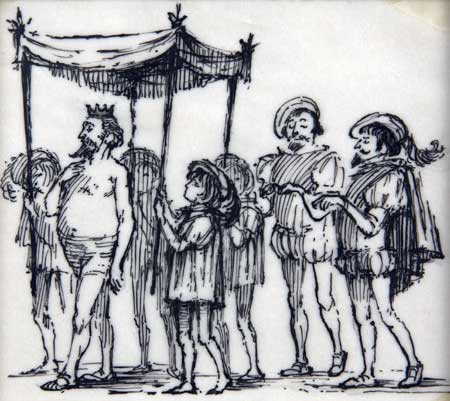
The phenomenon of postmodernism reminds me of the beautiful story of Emperor’s New Clothes. The emperor strode naked and yet nobody dared to tell him so. They were afraid of him. They had reasons to lie. They feared losing their privileges by telling the truth. It took a child to have the courage to reveal the truth to the king; to recognize it for what it was… bogus. I just wish we all had a little more of the child in us…

Wedding Song Tagalog Philipines

Their name comes from the native term tagá-ilog, or “people living along the river”, or from another term, tagá-alog, meaning “people living along the ford”. The ford is known to be that shallow part of a river where people, animals or vehicles can cross it. Like any other wedding, Tagalog celebration starts with an engagement. The first moment after the couple has decided to marry is the pamanhikan. The groom and his family visit the bride’s family in order to ask for her hand.
Speaking about the wedding attire, the white wedding dress became popular in the last century with America’s influence in the Philippines. Before, brides wore a colored or stylish black dress to celebrate a wedding. Speaking of flowers, orange blossom bouquets and adornments were very important during the last century. For the groom, the traditional Filipino formal wear is the barong tagalog.
The barong is a cool, transparent shirt from silky pina or jusi, two native fabrics, worn over black pants with a white t-shirt underneath. Filipino male guests will also come to the wedding in their best barongs.
In the past, a wedding ceremony lasted for three days. Each day has its rituals. On the first day, both bride and groom came to a priest, who joined their hands near a plate of raw rice. While joining their hands, they declared love for each other three times. After this, the priest fed them cooked rice from the plate and a drink of some of their blood mixed with water. This is interesting and unique.
Most of the Filipino weddings are in present Catholic weddings, having special “sponsors” as witnesses to the wedding. These could be godparents, counselors or even one of the parents. There are also some secondary sponsors that have special roles for the unity candle ceremony, the cord and the veil ceremonies. During the unity candle ceremony, secondary sponsors light two candles, which are then used by the bride and the groom to light a single candle considered to be the joining of the two families and the light of Christ in their new married life.
During the veil ceremony, veil sponsors put a white veil on the bride’s head and the groom’s shoulders. This is the symbol of two people clothed as one. As for the cord sponsors, they drape the yugal (a decorative silk cord) in an eight shape over the shoulders of the bride and groom to symbolize fidelity. The groom gives his bride 13 coins blessed by the priest, as a symbol of his dedication to their well-being and the welfare of their children.
Tagalog ceremonies and weddings are accompanied by traditional Tagalog music. Here are some of the most popular songs:
Ikaw by Martin Nievera and Kuh Ledesma
Tanging Mahal by Regine Velasquez
Maging Sino Ka Man by Erik Santos
Pangako Sayo by Rey Valera
You Are My Song by Regine Velasquez
Hanggang ngayon by Regine Velasquez
Carry My Love by Sarah Geronimo
Pangarap Ko Ang Ibigin Ka by Regine Velasquez
Ala Ala Mo by Sarah Geronimo
Kahit Na by Sarah Geronimo

Related Posts :

Keanekaragaman Budaya Rakyat Bali


Keindahan Denpasar dan Kuta di Bali selatan sudah menjadi buah bibir banyak orang hingga ke negeri lain. Namun, wilayah Bali selatan bukan satu-satunya tempat yang menyajikan objek wisata eksotis yang sarat keelokan pemandangan. Bali utara juga menawarkan beragam tempat wisata menarik.  Buleleng yang terletak di kawasan Bali utara, rupanya menyimpan kecantikan yang bisa membuat wisatawan yang datang berkunjung, terpikat. Kabupaten ini pun dinilai telah siap menyambut wisatawan yang berkunjung. Terbukti dengan digalakkannya kegiatan pembenahan di segenap lokasi wisata, untuk memberikan kenyamanan bagi para wisatawan.
Buleleng merupakan sebuah kabupaten di Pulau Bali dengan ibukotanya adalah Singaraja. Kabupaten Buleleng terletak di sebelah utara Pulau Bali yang memanjang 144 kilometer dari barat ke timur. Buleleng dapat ditempuh melalui jalan darat selama kurang lebih 3 jam dari Denpasar. Buleleng memiliki perpaduan sempurna antara kawasan pegunungan dengan perairan yaitu bukit dan gunung di sebelah selatan bertemu dengan dataran rendah berpantai di sebelah utara. Di Buleleng yang memiliki luas 136 hektar ini terdapat gunung berapi dan tidak berapi. Kawasan wisata di Buleleng ini terbagi menjadi dua, yaitu kawasan wisata Kalibukbuk dan Lovina. Di sebelah timur Buleleng, ada beberapa kawasan wisata air yaitu air terjun Les yang terletak di Desa Les kecamatan Tejakula, 38 kilometer dari Singaraja. Air terjun Air Sanih merupakan sebuah kolam renang alami di kecamatan kubutambahan yang berasal dari sumber mata air Gunung Batur. wisata puri juga merupakan pesona yang tidak dapat dilupakan antara lain Pura Beji, Meduwe Karang, dan Pura Dalem Jagaraga. Bagian tengah, Buleleng memiliki pesona wisata Pelabuhan Buleleng yang menyajikan pesona kejayaan pelabuhan Buleleng pada saat ini sudah menjadi restoran terapung. Puri Buleleng merupakan kawasan yang paling menarik yang mencitrakan kejayaan raja Buleleng di era Dinasti Ki Barak Panji Sakti.
Selain itu ada juga Pantai Lovina yang tidak kalah menariknya dikarenakan Pantai ini berpasir hitam, pantai Lovina terletak di Desa Kalibubuk 10 kilometer sebelah barat Singaraja, selain digunakan untuk menyelam, berenang, memancing, berlayar dan mendayung dikarenakan pantai lovina merupakan pantai dengan laut yang tenang. Berbeda dengan pantai Kuta maupun pantai Sanur, di Pantai Lovina tidak cocok sebagai tempat berjemur karena banyaknya ada sampan (perahu kecil) yang berjejer dipinggiran pantai. Sampan-sampan ini digunakan untuk aktifitas melihat atraksi lumba-lumba (Dolphin) yang jumlahnya ratusan di pagi hari.

Selain pantai ada juga dua Danau yaitu danau Buyan dan Tamblingan. kedua danau tersebut dianggap kembar karena letaknya hampir berdekatan. Dengan pemandangan danau yang membiru bertemu dengan kehijauan pegunungan yang berada di sekeliling kedua danau tersebut.

Keberadaan Agama Buddha di Buleleng ditunjukan dengan keberadaan Wihara Brahma Buddha Banjar, merupakan sebuah bangunan wihara bagi pemeluk agama Buddha di kaki bukit yang juga memilik pemandangan menawan menghadap Laut. Bangunannya yang kokoh ditonjolkan dengan adanya tugu lonceng yang merupakan sumbangan dari Thailand dimana panel-panelnya mencerminkan cerita Buddha lengkap dengan patungnya. Tidak jauh dari sana terdapat air terjun Melanting dengan sumber air panas yang dibuat bertingkat.
Di sebelah Barat Buleleng terdapat makam Jaya Perana dan Layon Sari, sepasang kekasih pada masa kerajaan Wanakeling Kalianget pada jaman dahulu kala. Ada pula Taman Nasional Bali Barat yang merupakan tempat berbiak jalak bali yang dilindungi. Jangan lewatkan Pulau Menjangan yang merupakan salah satu pulau di Bulelang Barat yang dikenal lewat pesona pemandangan bawah laut dan dijadikan sebuah taman nasional.

Thailand About Informations

Thailand Info

Information about Thailand

The Land Of Smiles
Thailand is a popular destination for many, which is not surprising when one thinks of all the excitement the country has to offer.  At the same time the prices are very low so you pay far less for all shopping, food and excursions than you do on a “boring” sight seeing tour in european countries.
One of the first things that can be highlighted in Thailand is the beautiful climate. The country is perfect for those looking for ex

otic beaches, palm trees and ocean, and there are numerous beaches. Everything from almost deserted islands to busy beaches with plenty of activity and high “party factor”. Thailand is also a paradise for diving and snorkeling, and the temperature of the sea is more than comfortable. North of Thailand, there is so much incredibly beautiful scenery and so much well lived culture that one can only wish for in our own lives. Thailand has  alot to offer whether you want sun and sea, or want to experience Thailand outside the main tourist sites.

Geography
Thailand has an acreage of just over half a million square kilometers and is about as big as France. The country stretches out, in all of 1770 km from north to south, and the elongated shape means that the climate is somewhat varied. Thailand borders Myanmar to the west, Laos to the northeast, Cambodia to the east and Malaysia to the south. The “Golden Triangle” in the north, meets many borders between Thailand, Burma and Laos all at once.
Climate
In Thailand, there is a warm and humid climate throughout the year, and the average temperature is from 28 to 35 degrees. At night it is usually only a few degrees colder than the day. The high humidity makes it feel hotter than it really is. The warmest period is from March to May and the rainy season is between June and September.  High season for tourists and the “coolest” time is between October and February.
Language
Thai is considered a very difficult language to learn. Thai is an audio language that has hardly any grammar, making that a word can mean up to 5 different things, but expressed in different ways. When one is visiting outside the tourist areas, it pays to have an interpreter with you, as the locals generally can not speak one word of English. In the major tourist towns and islands, the locals speak a sort of mixing language that you can make yourself understood with. I like to call it “baby-english”.
Customs
Thais are a proud people who are easy to get in touch with. They are hospitable and happy to help. They appreciate courtesy and a smile, and have very little time for those who can not control ones temper. In Thailand you have to remember to smile a lot, and not raise your voice in a discussion. You will not get anywhere with aggression, remember either to take it all with humor and a smile. If you feel cheated by a seller or there are any other things you are not satisfied with, say so but with a pleasant and jocular manner, and they’ll respond, in most cases, with the same courtesy.
For Thais the head is the most important part of the body, and it is seen as highly inappropriate to touch it to someone elses. At the same time one should be careful to not point out to someone the bottom of their feet. Going nude or topless on the beach, kissing or petting in public places, etc. is not respected in Thailand.
When you go to a village outside the big cities, it is important to look at yourself as a stranger and respect the people’s customs and living habits. Do not shoot wildlife with cameras without asking first, and do not hand out well-meaning gifts without having clarified this with the village leader.
Among the other “rules” that should be mentioned is that one must get up in the cinema when the national anthem is played before the show and that you always have to take off your shoes before going into a temple, and one should not step directly on the thresholds either.

Haggling

In shopping malls and hotel shops, prices are determined, and it is expected that you should not haggle. But however the street markets are where negotiating is a necessity. Most salespeople are poor at English, so they usually place prices with a calculator.  You can get the price down to between half and two thirds of the original offer and you both should be pleased.
Tip
Thais in general not expect tips, but if you smile and give a symbolic amount, you’re always well received at the next visit. Most common is it to give tips in restaurants and bars, but feel free to give a little to the hotel staff to help get you better service and also to some of those who clean and wash your room.
Toilets
Most hotels and restaurants have a flush, which we are familiar at home, but there comes a bit outside the towns and at some petrol stations are toilets of a very simple design. They have no seat, but a hole in the floor with some water in it. Besides, there is a bucket of water and a ladle to wash it down with, and they have hardly any toilet paper, so it pays to have a roll in your bag .
Thailand is more than just beaches and palm trees. History and religion make their mark in the country, so you feel that you are far away from home during the holidays. At the same time, it is one of the safest places to be a tourist, and locals are always friendly and helpful to strangers.
Activities offered are endless in Thailand. Besides everything you do on the sea and beaches, Thailand has exciting jungle areas, beautiful scenery, abundant wildlife, an exciting culture and delicious food. In Thailand you can buy most things at a very reasonable price, and the country is called “copy-land”, some clothes, watches, sunglasses, etc. make their mark on.But most of the replica selection is still good quality and looks quite like the original in most cases.
Come with us on the adventure of a lifetime with Thailand MC Tours!